E-Book
Stablecoins Playbook: How to Accept & Send Stablecoin Payments for Global Money Movement

Executive summary
Stablecoins are no longer a niche concept reserved for crypto insiders. Cryptocurrency payments have become a practical tool for organizations that want faster, more efficient ways to move money across borders, reduce costs, and meet the growing demand from customers and partners who prefer digital assets.
This playbook is designed for CFOs, finance leaders, payment executives, product managers, and business managers who want to delve deeper into the why and how of stablecoin integration. Whether your organization is considering accepting stablecoin payments from customers, sending payouts to employees or vendors, or both, this playbook will give you the clarity and frameworks to move forward.
Table of Contents:
Step 1: Determine your use cases
Step 2: Build the business case
Step 3: Compliance considerations
Step 4: Find the right partner
Step 5: Integration pathways
Step 6: Drive adoption and growth
Stablecoins integration checklist
Download the Stablecoins Playbook for free
Background on stablecoins
Stablecoin: A digital asset whose value is tied to a stable reserve (e.g., USD, EUR) to minimize volatility while enabling fast, borderless transactions.
Stablecoins are cryptocurrencies designed to maintain a stable value by pegging to an underlying asset such as the U.S. dollar, euro, or a basket of currencies. They combine the efficiency of blockchain transactions with the familiarity of fiat currency value, making them ideal for payments and transfers.
The stablecoin moment: why now
This moment marks a rare convergence. On one side, rapid growth in stablecoin transaction volumes and rising enterprise adoption. On another, regulatory clarity is taking shape, giving businesses the confidence to operate at scale.
In just the past few years, adoption has accelerated at a remarkable pace:
Market capitalization has grown from near zero in 2017 to over nearly $250 billion in 2025, with forecasts projecting $2 trillion by 2028 (Visa Onchain Analytics, Bloomberg).
Payment usage has surged, with $8.4 trillion in stablecoin payments processed in the past 12 months (Visa Onchain Analytics).
Enterprises and institutions are stepping in, from JPMorgan launching its own stablecoin-like token to Circle going public on the New York Stock Exchange.
BitPay’s own network reflects this shift:
Stablecoins now account for over 40% of all payment volume processed (BitPay internal data).
USDT leads with 61% share, followed by USDC at 38% (BitPay internal data).
The average stablecoin transaction size increased from $1,772 in 2024 to $3,000 in 2025 (BitPay internal data).
What’s driving this momentum?
Efficiency: Near-instant settlement across borders compared to 1–5 day wire transfers.
Cost savings: Transaction fees are often less than $0.01 compared to traditional rails (McKinsey).
Global accessibility: Particularly powerful in regions with limited banking access.
Availability: Transactions can be completed 24/7, 365 days a year.
Regulatory clarity: Frameworks such as MiCA and the GENIUS Act are fostering confidence.
Less volatility: Stablecoins maintain a lower degree of volatility due to being pegged to assets like USD and EUR.
The path to stablecoin payments
Step 1: Determine your use cases
Step 2: Build the business case
Step 3: Compliance considerations
Step 4: Find the right partner
Step 5: Integration pathways
Step 6: Drive adoption and growth
Step 1: Determine your use cases
The first step toward adopting stablecoin payments is to identify where they add the most value within your organization.
Accept payments from customers

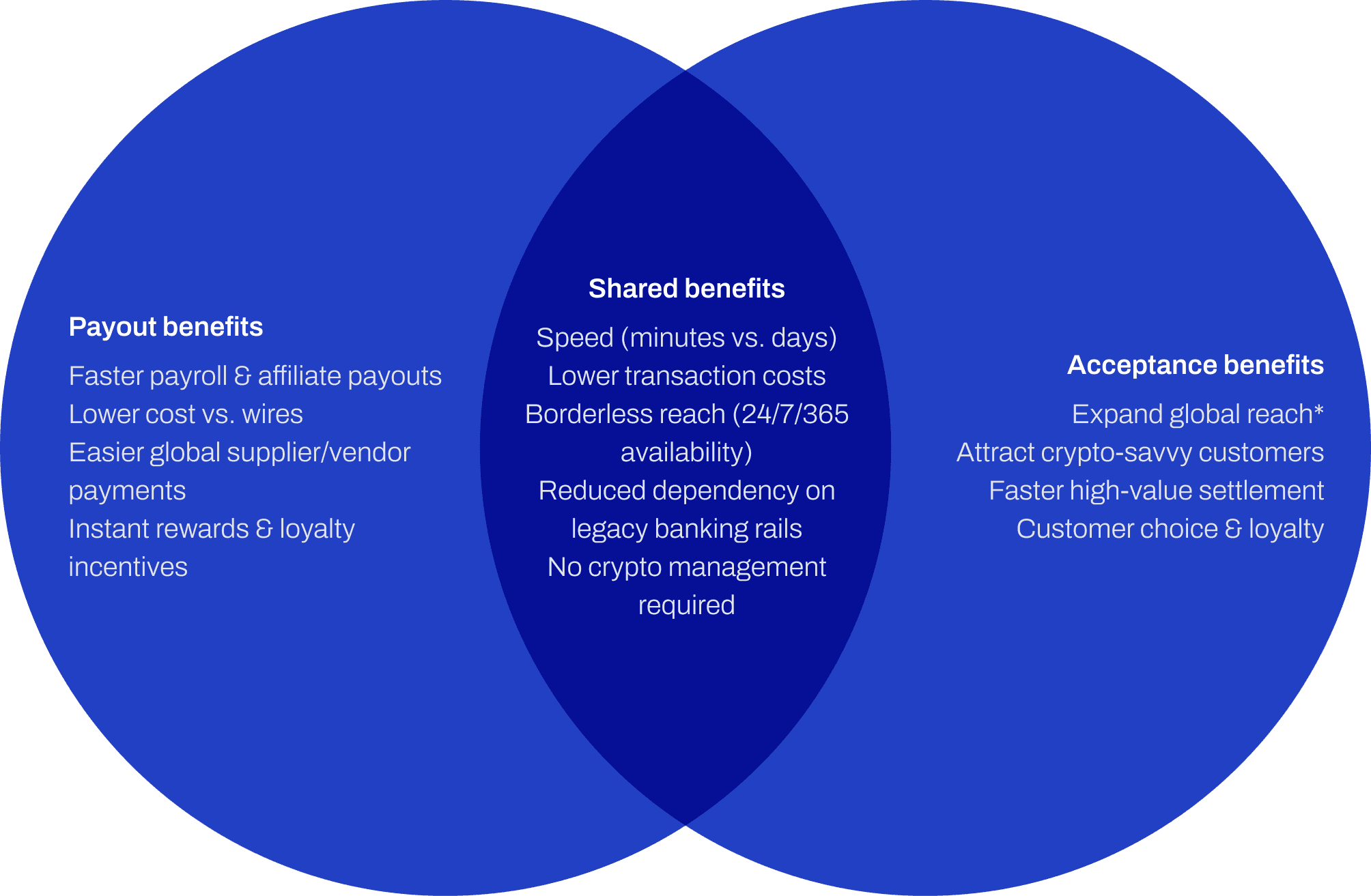
Stablecoins can be added as a payment option across various industries, including e-commerce, travel, luxury goods, software, donations, and even large-ticket purchases such as cars, boats, and real estate. Customers benefit from faster processing, lower fees, and global accessibility, while businesses benefit from lower payment processing fees and gain a competitive edge by meeting demand from crypto-savvy buyers.
Top use cases:
E-commerce - Reach global customers and eliminate fraud chargebacks.
Luxury retail - High-value customers often prefer stablecoins for speed and privacy.
Automotive and boats - Buyers can settle high-value purchases instantly.
Software and SaaS - Capture global customers who lack traditional banking access.
Real estate - Stablecoins streamline deposits, title transfers, and escrow.
Nonprofits - Donors can make contributions directly from their digital wallets.
Send payouts

Stablecoins are an efficient means of payment for payroll, contractor payments, affiliate commissions, and vendor settlements. Instead of waiting days for wires, recipients can access funds within minutes.
Top use cases:
Payroll and contractors - Pay global teams instantly without FX markup.
Suppliers and vendors - Simplify international settlements, especially in markets with weak banking infrastructure.
Affiliate payouts - Pay marketing partners, influencers, or resellers quickly across borders.
Step 2: Build the business case
Once you’ve identified where stablecoins fit, the next step is to make the business case internally. For finance leaders, that means quantifying cost savings and efficiency gains. For product and payments managers, it’s about customer experience, scalability, and market differentiation.
Legacy payment rails | Stablecoin payments with BitPay | |
|---|---|---|
Speed | 1-5 business days | Next business day settlement |
Fees | ~3% for credit cards, $25- $45 for outgoing wire transfers | ~1-2% |
International payments | Restricted by banks, FX fees, and local limitations | Borderless payments* |
Settlement | Delays from intermediaries | Payments settle on-chain |
Availability | Standard banking hours | Available 24/7/365 |
Chargeback fraud risk | Susceptible to fraud-related chargebacks | Irreversible payments eliminate fraud-related chargebacks |
Benefits for customers and partners
Stablecoins don’t just make your operations leaner, they create customer- and partner-facing advantages:
New, high-value demographics - Crypto consumers, especially in luxury, travel, and digital goods, often become loyal, repeat buyers.
Pass savings along - Lower costs can translate into lower prices or perks for paying with crypto.
Seamless UX - Customers can pay directly from their wallet or app of choice, avoiding card limits and banking delays.
Smoother cross-border checkout - No card declines or international transfer delays.
Flexible payment options* - Customers can pay and be paid with the stablecoin and network of their preference (e.g., USDC on Base, USDT on Solana, etc.).
Improved partner relationships - Faster, cheaper payments strengthen loyalty with partners, contractors, and vendors.
First-mover advantage
Organizations that move now stand to gain market leadership in efficiency and customer choice. Early adopters often see:
Increased conversion among crypto-savvy customers.
Positive brand perception as an innovator.
Stronger bargaining power with suppliers and partners seeking stablecoin payouts.
Aligning internal stakeholders
For adoption to succeed, multiple teams need to be aligned:
Finance - Understand cost, cash flow, and accounting impacts.
Operations - Ensure that settlement, reconciliation, and reporting integrate smoothly.
Sales and marketing - Position stablecoin payments as a differentiator in customer/partner messaging.
Risk and Compliance - Validate that your payment partner covers all regulatory obligations.
Step 3: Compliance considerations
Understanding compliance isn’t just about checking a box. It’s about protecting your business from legal pitfalls, financial losses, and reputational damage in a rapidly evolving crypto landscape.
Crypto regulations around the world
MiCA (EU): Effective 2024, this comprehensive framework regulates stablecoin issuers with strict reserve requirements, transparency standards, and consumer protections. Its goal: foster a safe and stable digital asset market.
GENIUS Act (USA): Enacted in July 2025, it establishes federal rules for stablecoins, requiring 1:1 reserves in safe assets, such as U.S. Treasuries. It also includes provisions for seizure in legal cases, providing clarity while encouraging innovation.
Together, these frameworks set the tone for a new era of safe, low-volatility, regulated stablecoin payments.
What this means for your organization
Reduce friction: Compliant stablecoins mean faster, lower-cost cross-border payments.
Minimize risk: Clear global standards reduce exposure to sudden regulatory shifts.
Stay ahead of the curve: Early adopters can tap into projected growth while remaining confident in compliance.
Compliance and risk simplified with BitPay
With BitPay, you can move forward knowing that:
We’re licensed in multiple jurisdictions, ensuring alignment wherever you operate.
We have over 10 years of experience in crypto payments, trusted by global enterprises.
Our enterprise-ready compliance framework includes dedicated personnel for robust AML, sanctions screening, and risk management.
The result: you stay focused on growth and customers, while we handle the complexities of compliance and risk.
Step 4: Find the right partner
Once you’ve aligned your organization and made the business case, the next step is selecting the right partner to power your stablecoin payments. This is one of the most important decisions you’ll make. The partner you choose determines how smoothly you can scale, how much risk you take on, and how quickly you see value.
The cost of operating independently
For most enterprises, integrating stablecoin payments in-house is a time-consuming, expensive, and risky process. A qualified partner like BitPay removes these barriers, allowing you to focus on growth rather than building payment infrastructure.
Task | DIY Efforts | With BitPay |
|---|---|---|
Technical infrastructure | Develop and maintain custom blockchain integrations, nodes, and APIs | Ready-to-use APIs, plugins, and hosted checkout solutions maintained by BitPay |
Security & fraud prevention | Build fraud monitoring, wallet security, and transaction risk management | Proven enterprise-grade security |
Customer support | Train internal teams to handle crypto-specific issues | BitPay supports both merchants and end users, reducing operational overhead |
Settlement & reporting | Build custom reconciliation, reporting, and treasury workflows | Settlement in fiat, reporting tools via dashboard/API |
Scalability | Ongoing dev resources to expand features and integrate new networks | BitPay continually adds support for new blockchains, assets, and features |
What to consider in a payment partner
Payment partners should be thoroughly vetted. Some of the most important topics to discuss include:
Reputation and track record
Compliance and licensing
Product depth
Integration scope and support
Payments + payouts
Settlement flexibility
Integration options
Service and support
→ Get the top 50 questions you need to ask payment providers
How BitPay stands out
BitPay has processed more than $7 billion and more than 13 million transactions since 2011
Experience you can trust
Processing crypto payments since 2011, BitPay is the longest-operating company in the cryptocurrency industry.
Enterprise-ready compliance
Licensed in multiple jurisdictions, with built-in AML/Sanctions compliance.
Breadth of support*
Accept and send payments leading stablecoins, in addition to other top cryptos, across major networks; compatible with practically any wallet.
One platform, two use-cases
Unified support for both customer acceptance and global payouts.
Flexible integration
From simple email billing to full API deployments.
Trusted by leading brands
Used by merchants in e-commerce, luxury, automotive, travel, real estate, and more.
Step 5: Explore integration pathways
Integrating stablecoin payments doesn’t have to be complex. The right partner provides multiple entry points, allowing your organization to choose the best fit, prove value quickly, and scale as adoption grows.
Payment integration paths at a glance
BitPay offers multiple methods to fit your business. The best solution depends on your market, payment channels, and organizational preferences.
Online Checkout | Invoicing | Point-of-sale (POS) | Payouts | |
|---|---|---|---|---|
Accept cryptocurrency on your website, just like any other e-commerce payment method. | Generate and email crypto invoices for B2B payments, services, or high-value purchases. | Use Quick Checkout or compatible Verifone terminals for in-store crypto payments. | Mass or individual disbursements to employees, vendors, affiliates, or customers. | |
Popular use-cases* |
|
|
|
|
Integration methods |
|
|
|
|
Integration options for every level of effort
BitPay’s integration pathways cater to any capability level, allowing you to choose between no-code simplicity and enterprise-grade APIs.
No Code: Get started fast | Low Code: Add flexibility | Custom integration: Full customization |
|---|---|---|
|
Step 6: Drive adoption and growth
Launching stablecoin payments isn’t the finish line; it’s the starting point. Real ROI comes from building awareness, trust, and adoption across every touchpoint.
Educating your customers
Add clear payment messaging at checkout (“Now accepting USDC, USDT, and more”).
Update website FAQs with step-by-step guides on how to pay with stablecoins.
Offer short tutorials or explainer videos to reduce friction for first-time users.
Promote acceptance in customer emails, social media, and loyalty programs.
Empower your partners
It’s not just customers who need education. Your vendors, suppliers, and affiliates also benefit when they understand the advantages of payouts in stablecoins:
Communicate how they’ll receive payments (wallet setup, supported assets).
Share benefits: faster payouts, fewer fees, no waiting for wires.
Provide onboarding materials and FAQs to facilitate easy adoption.
Marketing your adoption
Stablecoin acceptance can be a brand differentiator:
Co-market with BitPay to expand your reach and enhance your credibility.
Announce your new payment options in media highlights, press releases, and thought leadership.
Use social media campaigns to reach crypto-savvy buyers.
Stablecoins integration checklist
Use this quick checklist to ensure you’re ready to move forward with stablecoin payments:
Defined your use cases (acceptance, payouts, or both).
Built the business case and aligned across your organization.
Consider regulatory requirements in your markets.
Chosen the right partner to handle stablecoin payment processing.
Implemented the integration method that fits your organization
Planned education and adoption campaigns for customers and partners.
Ready to kick off your stablecoins strategy?
Connect with a BitPay expert to explore solutions tailored to your market, channels, and customers.
*Restrictions and geographic limitations may apply
*Terms and conditions apply; certain industries may be restricted and/or require additional review by BitPay before onboarding.
Note: All information herein is for educational purposes only, and shouldn't be interpreted as legal, tax, financial, investment or other advice. BitPay does not guarantee the accuracy, completeness, or usefulness of any information in this publication and we neither endorse, nor are we responsible for, the accuracy or reliability of any information submitted or published by third parties. Nothing contained herein shall constitute a solicitation, recommendation, endorsement or offer to invest, buy, or sell any coins, tokens or other crypto assets. BitPay is not liable for any errors, omissions or inaccuracies. For legal, tax, investment or financial guidance, a professional should be consulted.